The latest report on in-housing from the US-based Association of National Advertisers (ANA) paints a positive picture of a sector that is “more capable, more strategic, and more embedded in the business than ever before”.
For its 2026 State of In-Housing report, the ANA surveyed 404 jurors of its 2026 ANA In-House Excellence Awards, consisting of “brandside marketers, agency professionals, and independent consultants with direct, day-to-day experience running or partnering with in-house teams”. The report was published against the background of well-publicised fears of “un-housing” in the US after the 2025 closure or downsizing of high-profile IHAs at Keurig Dr Pepper, Expedia and others.
The ANA report robustly dismisses the idea that those moves represent a negative trend: “The closures that made news in 2025 reflected individual business decisions, not a reversal of a movement that has been building for two decades,” it states. “In-house agencies are not a trend. They are not a cost-cutting experiment that runs its course when the budget tightens. They are a structural part of how modern marketing organizations operate.”
The research found that only 7% of respondents believed that marketers were pulling back from in-housing, while 35% agreed that “marketers are in-housing more than ever”.
In its last report, in 2023, when respondents were asked to name the primary benefit of IHAs, 30% cited cost efficiencies, the top answer by a distance. In this year’s report, only 9% saw ‘Cost-saving alternative to external agencies’ as an IHA’s primary benefit. We should note that the question asked here was slightly different but, nonetheless, the difference does underline a shift in perception. As the ANA puts it, “Despite the rationale that many in-house teams get their start as a cost-saving option from using external partners, only 9 percent see that as the primary role of internal teams today.” Fifty-three percent of respondents expected in-house agencies, first and foremost, to deliver big creative ideas at a strategic level.
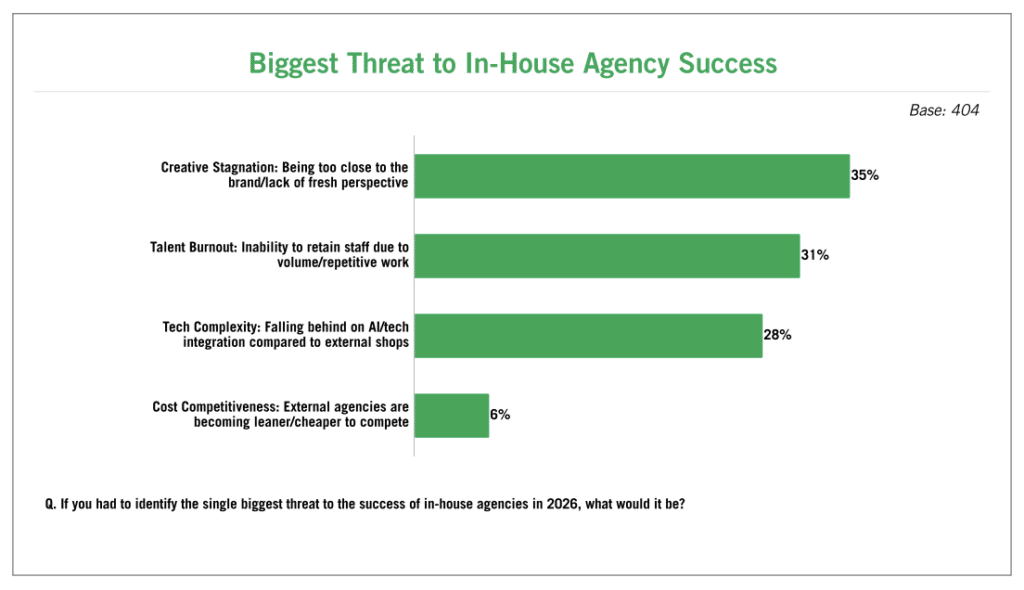
According to the report, the biggest threat to in-house agency success is seen as “Creative Stagnation: Being too close to the brand/lack of fresh perspective”. This is closely followed by “Talent Burnout: Inability to retain staff due to volume/repetitive work” and “Cost Competitiveness: External agencies are becoming leaner/cheaper to compete”.
Nevertheless, 34% of respondents saw IHAs expanding their scope with work moving from external partners to in-house. Ony 7% saw work going the other way.
We’ve noted before that US in-house agencies are much more likely to handle media than their UK counterparts. The report finds that 67% of IHAs responding handled media. The most common function handled in-house is Social (58%), followed by influencer/creator marketing (37%) and SEO (35%).
As for AI, 49% report that “AI is allowing the in-house team to do more work, but external spend remains the same”, while 19% agree that “AI is allowing the in-house team to produce work that was previously outsourced”. In terms of creative development, only 18% report “Significant positive impact: Clear cost savings and productivity gains” through AI. 49% report a “Moderate positive impact” while 21% say it is too early to tell what the impact of AI will be.
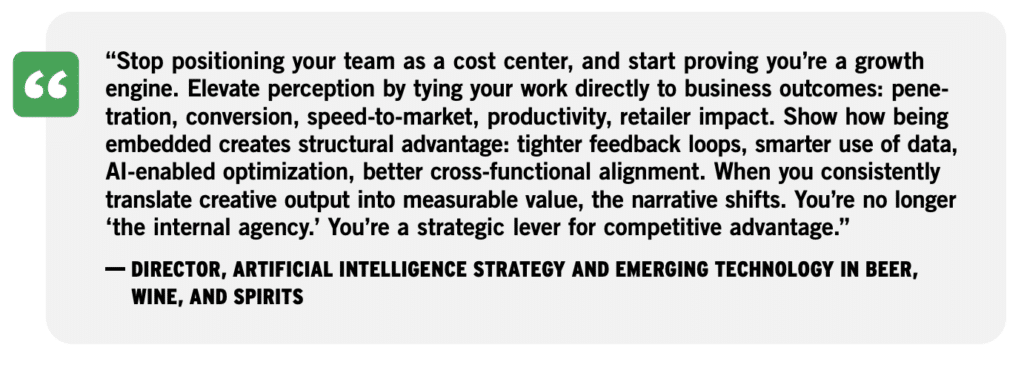
The report ends with a warning note: “Despite survey results that paint a largely optimistic picture of in-housing today, the reality remains that teams must find better ways to demonstrate and amplify their value. With greater value comes increased capabilities, headcount, and scope,” it says.
The perennial issue for IHAs is in finding ways to link “in-house outcomes to measurable business impact”. As one respondent says, “Stop asking for a seat at the table. Build the table. In-house teams get trapped seeking validation from the C-suite when they should be creating frameworks the C-suite can’t ignore. Want respect? Own a metric that matters. Revenue pipeline. Customer lifetime value. Cost per acquisition that’s 40 percent better than agency benchmarks. The fastest way to elevate perception is to make your work indispensable to someone else’s bonus. Connect your creative output directly to commercial outcomes, then report on it relentlessly. Executive teams don’t respect marketing sophistication. They respect math that makes their lives easier.”
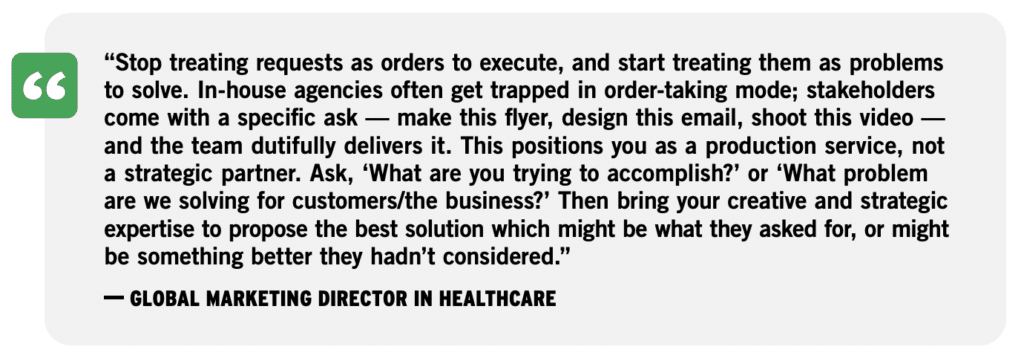
As the report’s authors argue, in order to continue to evolve and grow, IHAs must “Move upstream, connect work to outcomes, tell a value-based story, and achieve world-class operations. In-house agencies have spent two decades earning a structural role in modern marketing organizations. The path forward is not to defend that position; it is to build upon it.”
For more on the ANA’s 2026 State of In-Housing Report and to download a copy, go here